GM Session Prep Cycle
The Invisible Work That No Tool Helps With
October 28, 2025
My sessions run on Tuesday evenings. I've told my players that in order to prep properly, I need to be in the right mindset: last minute panic. This is probably not ideal.
Over the years, I've spent a lot of time preparing for TTRPG sessions - first D&D, and now Daggerheart. I've read a lot of different perspectives on how to prepare for sessions, and I've tried a lot of different tools. I've particularly learned a lot from the Lazy DM methodology. I've found it to be incredibly helpful in my own process, and in thinking about what makes for a great session in general. There's another layer that I've found to be just as important, but that is often overlooked: the invisible work that turns what happened last session into a playable, coherent next session.
My goal here is to be even more lazy about my prep process, by creating a bit of structure around the workflow from week to week. I'm not starting each session from scratch, but rather building on the work I did the previous week. I want my process, and especially the tools that support that process, to take on as much of the heavy lifting as possible and free up my brain for the creative parts of GMing.
So, I broke my workflow down into seven steps. These are the things I do every single week; sometimes under more time pressure than others.
1. Combine previous session prep with notes from playing
Your notes from last session are a mix of what you planned plus what the players actually did. We play online, which helps a bit with this because I can pull a transcript from the audio. It's a bit of a mess, but that's getting a bit better all the time. I also try to keep my own notes on names and any other ad hoc details that I think are important. I especially try to keep track of anything that the players threw unexpectedly into the mix. I can't count the number of times I've had an idea of what a reveal might be, only for the players to speculate something even better – which of course is now what I'd always been planning all along!
One thing I like to keep track of is a kind of "quest list". This is a list of things that the players have committed to doing, or that are otherwise hanging over their heads. It's a way to keep track of the story threads that are still alive, and to make sure that I don't forget about them. It's also familiar to (some) players from video games and other media.
Together they form an ongoing story arc.
2. Revise for where the story is going next
Next, I sit and think a bit. If I'm running a pre-written campaign, this will be a bit of reading and re-reading, maybe some research. If it's more of a homebrew or frame-based campaign, it's an opportunity to think about each character's motivations and goals, and how they might be affected by the events of the last session. It's also a chance to think about the overall story arc, and how the players' choices are shaping it. I like the concept of fronts, which I think of as the world moving forward whether the players are aware of it or not.
3. Figure out where the session is going to start
In order to prepare a session, I need to know a bit about the shape of that session. This is zooming in from where the story is going - it's more about the mechanics of the session than the broader story arc(s). What story beats do I want to hit, and how do I get there? Trying to map out all the potential branching paths that the players might take isn't realistic, and it's not necessary. I want to have a few potential scenes in mind, and I want to focus my attention on the ones that are most likely to happen. That helps us to have a kind of framework or skeleton for the session. It's like an inventory of the locations, NPCs, secrets, and other resources that I'll want to have at my disposal.
When things go off the rails (and they always do), that little inventory is what keeps me from flipping through tabs mid-session.
4. Build out the world a little bit
I know there are GMs out there who want to live entirely in this space. There are interesting tools out there for building incredible worlds and managing extremely intricate inter-connected histories for empire-spanning dynasties. But I'm not one of those GMs. I'm not Matthew Mercer, or Brennan Lee Mulligan, or Tolkien for that matter, and I think that's okay. On the other hand, I do want to have a sense a world that makes sense, that has a logic and history and flow to it, and that isn't filled with generic or bland details. I like to think of it as there being a fog-of-war surrounding the party in time and space - things should be looming in the vicinity, but beyond that there's a lot of room for creativity and improvisation.
5. Create mechanics-driven snippets
There are some part of the adventure that need specifics. They're mechanical, and they follow rules or at least guidelines. These are often combat-specific, but not always. Some of them are environmental, or related to some kind of social or clandestine interaction. I want to get these written down in a way that is easy to refer to at the table. I often need many of them at the same time, which is its own challenge. I love the approach that Flee Mortals takes, with interesting adversaries with strong themes and motivations.
6. Pull it all together into something usable
You can see how there's a lot of organization and synthesis happening here. It's real work, and it's competing with the creative parts of GMing for my time and energy. This is where I start to feel like I'm doing work that has no payoff. Too much of it is repeated from session to session, and a bit of a memory exercise. This is the part where I want to hire an assistant...
7. Write the introduction / recap
This is the section that my players have consistently loved: a proper recap at the beginning of each session. It doesn't have to be long, but it should be a chance to remind the players of where we are in the story; it's a chance to hand them the threads that you want them to pick up on for the session. If there's a thread, villain, opportunity, or anything else that the characters would have top of mind, it's a chance to kindle that in the minds of the players as well.
They have busy lives that take them away from the adventuring world between sessions, and a proper recap is a chance to bring them back into the story.
So I write a short recap as if there's an audience at home watching the stream to be read directly at the beginning of the session, and I lead from that right into the initial scene.
Why this workflow matters
This seven-step process isn't glamorous. It's repetitive, often tedious, and no existing tool helps you move through it efficiently. Most GM software focuses on storing content, generating maps, or creating encounters. Not on turning last week into this week.
It's not hard, exactly. In some ways it's simple, but simple isn't the opposite of hard. I think there's room for it to be easier, and I think there's room for it to be more fun.
So I built Campaign Arks. It won't run your campaign for you, but it frees you up to focus on the creative parts. It's a GM assistant for session prep.
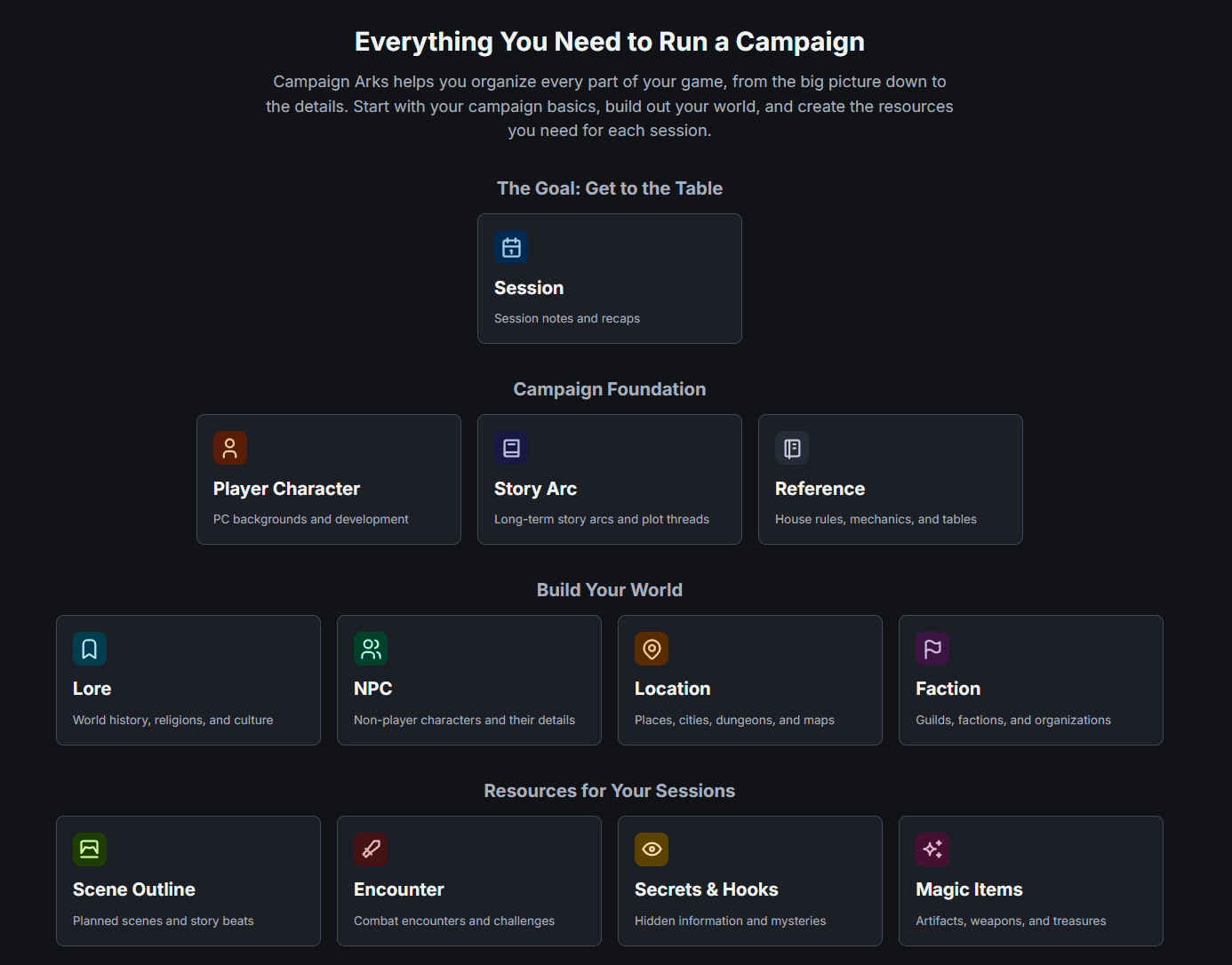
A workflow tool for modern GMs
I built Campaign Arks for myself, but I know I'm not alone in this. If you've ever stared at a blank page, scrolled through messy notes, or scrambled to remember where your story left off, then this workflow might feel familiar. I strongly believe that efficient session prep makes for better campaigns, and better stories.
If you're interested in learning more about Campaign Arks, give it a try. You can find it at campaignarks.com.