DnD Character Backstories: What to Ask Your Players For
The brief to send before session zero, and what to do with what comes back
October 24, 2026
A DnD character backstory is useful to a GM when it gives you people and problems you can put on stage. Ask each player for a few sentences: what their character wants, why they travel with this party, two people from their past who are still alive, a problem that isn't solved, a blank or two for you to fill, and anything that's off-limits. Then read each one for hooks, and give every character one in each session's prep.
Most backstory guides are written for the player, and most of them end with some version of "talk to your DM." This one is for the GM on the other end of that conversation. It covers the brief to send before session zero, how to pull hooks out of what comes back, what to do when a backstory runs to ten pages or never arrives, and how to keep a whole party's backstories in play over a long campaign. At the end, one backstory is worked through from three sentences to the first three sessions. None of it depends on the rules, so it works the same in D&D, Daggerheart, Pathfinder, or Call of Cthulhu, and several of those games build parts of it into character creation.
What should you ask players for in a backstory?
Pitch the campaign first. Sly Flourish, on tying characters to a campaign's theme: "It's important to push this theme before they start working on their characters. It's harder to shoehorn the theme onto a character if they already have one built." A player who knows the game is about debts and merchant houses in a river city writes a different rogue from one who was told "fantasy, level 1."
Then ask for a short list. The GMs who write about this disagree on length, but the parts they use are the same:
- What the character wants, and what's in the way. On RPG Stack Exchange, Carl Cravens answers a GM asking how to get plot hooks from players with "What does the character want that he is prevented from having, and what is preventing him? This is storytelling 101". It's also the Alexandrian's question for a player who has written nothing: "Where's your momentum coming from? What is driving you? What do you want to achieve?"
- A reason to travel with this party. Sly Flourish's version: "The character doesn't have to like adventuring with others but they should be motivated to do so anyway."
- Two people from their past who are still alive, each with a name, what they want, and how they feel about the character. You'll use these more than anything else, because a person can walk into a scene. Blades in the Dark builds this into character creation: every character marks a close friend and a rival from their playbook's list of people. Call of Cthulhu's Quick-Start Rules give the backstory a place for "significant people in their life, treasured possessions, and locations that are important to them."
- One problem that isn't solved. In an EN World thread on session-zero backstories, Distracted DM describes the kind he keeps getting, with the conflict wrapped up before play starts: an elf who bargained her soul to a demon to save her parents, saved them, and paid the demon with the would-be murderers' souls instead. His verdict: "It would have been much more usable if the fiend was still promised your soul."
- A blank or two: something the character doesn't know about their own past, left for you to decide. Matt Mercer, via the Alexandrian: "Back story is an invitation to the GM; not an expectation."
- Anything they'd rather you didn't touch. A player who has written their mother into a backstory should get to say whether she's safe.

Ask for a sentence or two on each and take what you get (the FAQ below covers length). Whether the list above is in it matters more than how long it runs.
Here's a version to paste into your group chat a week before session zero:
Before we start, answer these about your character. A sentence or two each is plenty.
- What they want, and what's in the way.
- Why they'd travel with this group, even if they don't like them yet.
- Two people from their past who are still alive: a name, what that person wants, and how they feel about your character.
- One problem that isn't solved yet.
- One or two things your character doesn't know about their own past. I'll decide them, and you'll find out in play.
- Anything from your past you'd rather I didn't touch.
Write more if you like.
Tie the characters to each other at session zero, out loud. Daggerheart's character creation has every player "Suggest at least one connection between your character and each other player's PC," and each player keeps the ones they want. Fate Core's phase trio goes further: each player describes a recent adventure, and then writes their character into two other players' adventures. Either works in any game. The Alexandrian's version works through the people in the backstories: "Could an NPC from Character A's backstory be marrying Character B's sister?"
How do you turn a backstory into hooks?
Read it once and make a list. Write down every named person, every place, every debt, promise, or grudge, and every question the backstory leaves open. Those are the things you can put on stage. The rest tells you who the player wants to play, which is worth knowing, but it won't fill a session.
Then give each person on the list something they want now. A backstory shows people as the character last saw them, often years ago. Decide what each one wants today and what they're doing about it, the same way you'd give a faction its next steps. A sister who runs with smugglers is a fact. A sister who needs a boat before the new moon, and knows her brother has just come into money, is a scene.
Those people are yours to run once the game starts. KRyan, answering a GM whose players wrote too much backstory: "any NPCs introduced in a player's backstory are NPCs and you control them as appropriate during the game." A player who invents them has done some of your prep for you.
Send the backstory back with a few questions. The Alexandrian builds characters with his players over several rounds of email: the player sends a concept, he adds details or options, and then he has them "send that back with notes." Ask about a person or a place, like who the character would go to for help, and not about events the player has already written.
You can also add to it. For his Rime of the Frostmaiden game, Sly Flourish wrote a table of secrets and had each player roll on it, telling them their result privately: "If they like it, they keep it. If they hate it, they roll again for a new secret." Nobody sees the whole table, so nobody can guess another player's secret.
What do you do when a backstory doesn't fit?
Four problems come up again and again on GM forums.
It runs to ten pages
Read it for what the player cares about. As the accepted answer on that RPG Stack Exchange question puts it, a player who writes ten pages in good faith is "telling you what they are interested in!" Make your list from it like any other, then ask the player which two or three things on the list they most want to see come up.
There isn't one
Don't punish it. When a GM asked whether to give punitive backstories to players who didn't write their own, the accepted answer was to replace punishment with "supportive measures assisting these players." Ask the brief's questions out loud, which takes five minutes, or let the backstory come out in play: when a character recognizes a spell or a face, ask the player where they've seen it before. Some players never want a backstory at all. Spend that time on the players who do.
It puts the character at the center of the world
The secret heir, the last of an ancient bloodline, or a vendetta against the emperor. The accepted answer on reining in a backstory is to spell out what that vendetta would cost the character, then "ask him one simple question. Do you still want to have a vendetta against the Emperor?" A grand backstory is fine if the player takes what comes with it. Say no to the one that's really equipment, like the noble family that comes with a trust fund and a private army.
The other cost is to the rest of the table. A backstory works best when the player can choose to chase it, and the world doesn't turn around them. Shrink it to a size that leaves room for everyone else's: an heir to a minor house with a cousin who wants the seat gives you the same story.
Everyone they loved is dead
The orphan whose family was murdered is the classic backstory GMs complain about, and players have a reason for writing it. One player in the EN World session-zero thread would rather kill off a character's family deliberately than have a GM turn them into "convenient bad-guy-of-the-moment victims." The Alexandrian lists that habit among the GM's mistakes: "The classic example is targeting characters from the PCs' backstory and killing them off." If your players trust you not to do it, you'll get more living people. And an orphan still has people: ask who raised them, who they owe, and who's still looking for them. The example at the end starts from one of these.
How do you bring backstories into your sessions?
Make it part of your prep. Step one of Sly Flourish's Lazy DM prep is reviewing the characters and asking, for each one, "What hook can I include in the next session to draw this character into the game?" Pick each hook from that character's list. Sly also puts the characters into his secrets, with several on each session's list tied to the party.
Use the backstory to start things, and let the adventure be about what the party does next. Thomas Markov, on using backstories without letting them take over the plot: "Think hook, not fish." The brother who needs help and the creditor who offers to forget the debt both make good quest givers. The world can move without asking, but the character's own quest stays with the player. Resolve it without them, and you've taken away their reason to play it, which is the complaint in a D&D Beyond thread from a player whose GM did exactly that.
Keep track of whose hooks came up. A note after each session of which character's thread was pulled is enough to show when someone has gone three sessions without one.
Over a long campaign, backstories run out, because they get resolved. When a thread closes, ask the player a new question. One GM in an EN World thread on backstories does this every few sessions, usually at the start of one: each player says how their character is feeling, and what they've learned about the others.
Example: from three sentences to three sessions
Here's one idea worked through, starting from the kind of backstory GMs dread. Magot Brigge is the halfling rogue from the Bishop's Lenn campaign in the guide to making characters, a river trade city run by three merchant houses. Say her player sends this:
Magot is a halfling rogue. Her mother died and House Wesenham took everything. She wants revenge.
That's the dead family and a vendetta against one of the most powerful houses in the city, in three sentences. Make the list anyway:
- People: her mother, who is dead, and House Wesenham, which is a building, not a person.
- Grudges: whatever Wesenham took.
- Open questions: what it took and how, and who is still alive.
There's nobody to put on stage yet, so the questions back to the player go looking for people:
- "Who at Wesenham did you actually deal with?"
- "Is anyone in your family still alive? Can I use them, or are they off-limits?"
- "Why travel with this party instead of going after Wesenham alone?"
Say the answers come back like this. When her mother died, Wesenham paid for the funeral and took the house for the debt, and Magot still owes them forty crowns, which goes up every quarter day. She pays it down by carrying parcels for the house's factor, Alice Fincham, who is always polite and has never once asked how Magot is. Her older brother Hankin went to sea last spring and hasn't written. He's fair game, as long as he doesn't die offstage. And she travels with the party because Bartholomew, the wizard who was expelled for reading a merchant house's ledger, can read, and she has a page torn from a Wesenham ledger that she hasn't shown anyone.
The list now has people on it:
- People: Alice Fincham, Hankin, and Bartholomew.
- A clock: the debt goes up on the next quarter day.
- Blanks: what's on the page, and why Hankin hasn't written.
The revenge is still there, but now it has a face and a size: one factor, forty crowns, and a torn page, which leaves room for the rest of the party.
What each person wants now: Fincham wants the page back. She knows one went missing but not who took it. Hankin is the other blank, and the player has handed him over, so the answer is yours. When two blanks can share an answer, one reveal pays off both. Say the page shows House Wesenham collecting the insurance on the Margaret's cargo a week before she sailed, because it knew she would never arrive. Hankin was aboard, survived, and is hiding downriver because of what he saw. Pencil that in, and keep it loose until the table gets near it.
Then one hook per session, beside the other characters' hooks:
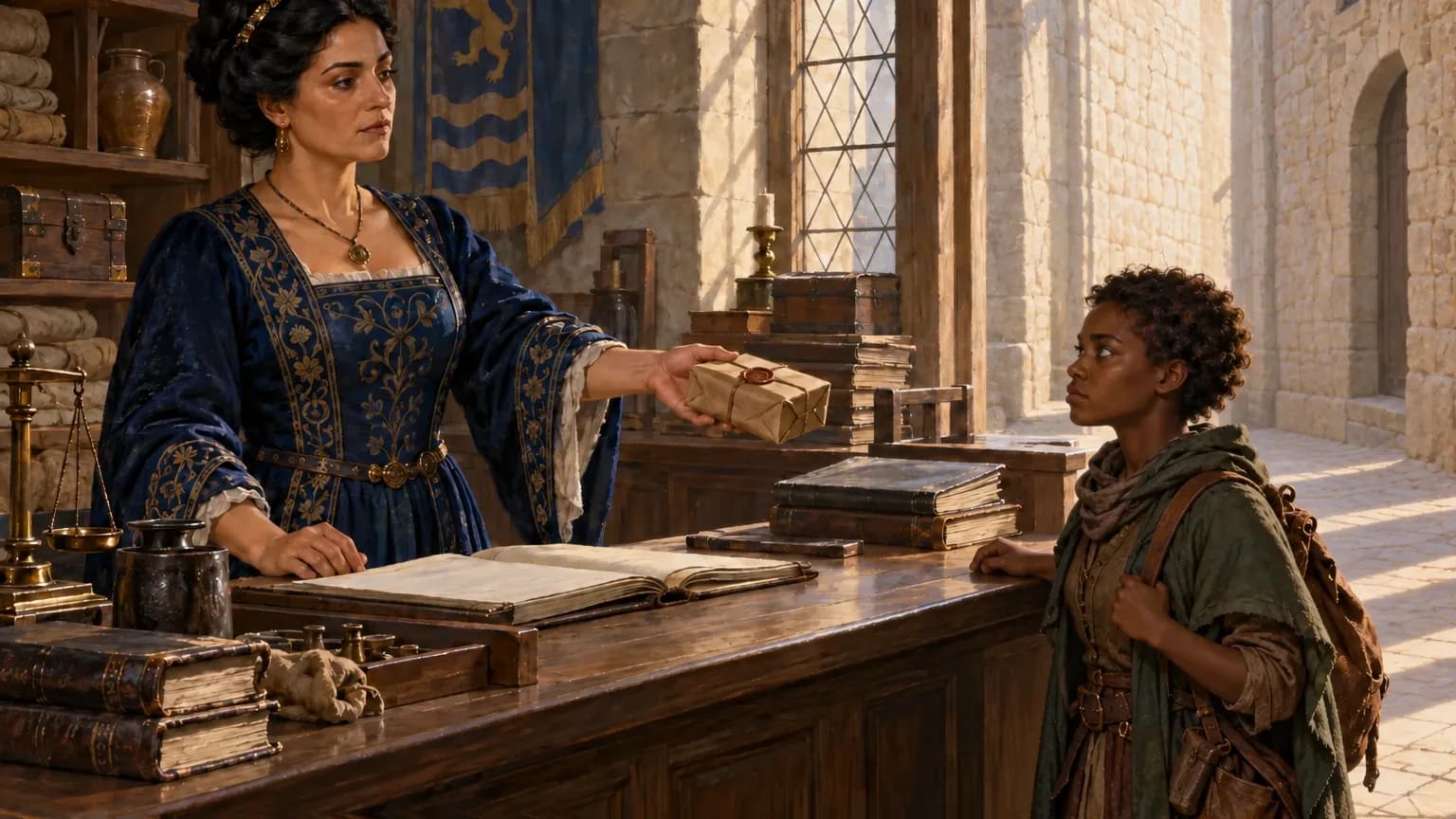
- Fincham hands Magot a parcel to deliver by midnight, on a night the party has somewhere else to be. Whether she carries it, skips it, or opens it is up to her.
- A sailor on the quay is wearing Hankin's coat. He bought it downriver from a man who needed money fast.
- On the quarter day the debt goes up, and Fincham makes Magot an offer: the whole debt forgiven for any Wesenham papers she comes across. Fincham doesn't know Magot has the page. Whether Magot sells it, bluffs, or uses the offer to get inside is up to her player.
Two secrets go on the session's list, to be found wherever the party looks: the Margaret's insurance was paid out before she sailed, and a man who looks like Hankin was seen alive downriver.
Here's her entry in the GM's notes after that work:
Magot Brigge. Wants revenge on House Wesenham; for now, out from under the debt. People: Alice Fincham (wants the missing page back), Hankin (alive downriver, hiding; Magot doesn't know; usable, but no offstage death). Clock: the debt goes up on the next quarter day. Blanks: what's on the page (penciled: the Margaret insurance), why Hankin hasn't written. Hooks used: the parcel (session 1).
Where Campaign Arks fits
A party's worth of backstories, each with its list of people, its clocks, and its penciled answers, is a lot to hold over a year of play. Campaign Arks is a session-prep assistant for GMs of any tabletop RPG, and it keeps a campaign as documents. Players join with an invite link, and each can own their character's page and edit it themselves, so the backstory sits next to your prep instead of in a group chat. A follow-up question can go to a player as a note that only the two of you can read. On Pro, Draft next session reads your recent session logs and prep and drafts the next session for you to edit, including where each character stands after the last session and the hooks still riding on them.
Prep your next session in Campaign Arks
Prep my next session · Free for one campaign, forever · No credit card
Frequently asked questions
How long should a DnD character backstory be?
A sentence or two on each item in the brief is enough for a GM to work with, and a page is plenty. Sly Flourish asks for "one to five sentences instead of one to five pages." Gnome Stew's J.T. Evans asks for half a page to a page for the GM and two paragraphs at most for the table, and the short version also lets a player "keep secrets or shameful events between you and the GM." In an EN World poll, 67 of 99 players said they bring somewhere between a few sentences and three paragraphs.
Can I kill or corrupt an NPC from a player's backstory?
Ask first. The accepted answer on who decides how backstories tie into the game suggests asking the table questions like "How much control over your brother should I have" and "Is it okay for me to keep information about important characters secret from you in order to reveal it later". The last item in the brief above covers this before it comes up.
Should I reward players for writing a backstory?
Some GMs do. CleverNickName, the GM who started the EN World poll thread: "one time, I let them have a free healing potion if they gave me 300 words or more." Several games build the reward into play instead. Fate pays a fate point when a player accepts a compel, a complication drawn from one of their character's aspects. D&D's 2014 rules award inspiration when you "give in to the drawbacks presented by a flaw or bond." Both reward playing the backstory rather than writing it.
Can a player change their backstory partway through a campaign?
Anything that hasn't come up at the table yet can change freely. Daggerheart's rules let a player "leave your character's past more ambiguous for the time being and discover their backstory through play," and filling in the blanks as you go is the point of leaving them. What the table has already seen is harder to change, so talk it through with the player first.
What if a player's backstory was written with ChatGPT?
Ask for the same brief either way, and check it the same way: a want, living people, an open problem, blanks. If it reads like every other backstory, the guide to making characters with AI covers getting past the first draft.