Creating Unique D&D Characters With AI
What makes a character work at the table, and how to get AI past its first idea
September 29, 2026
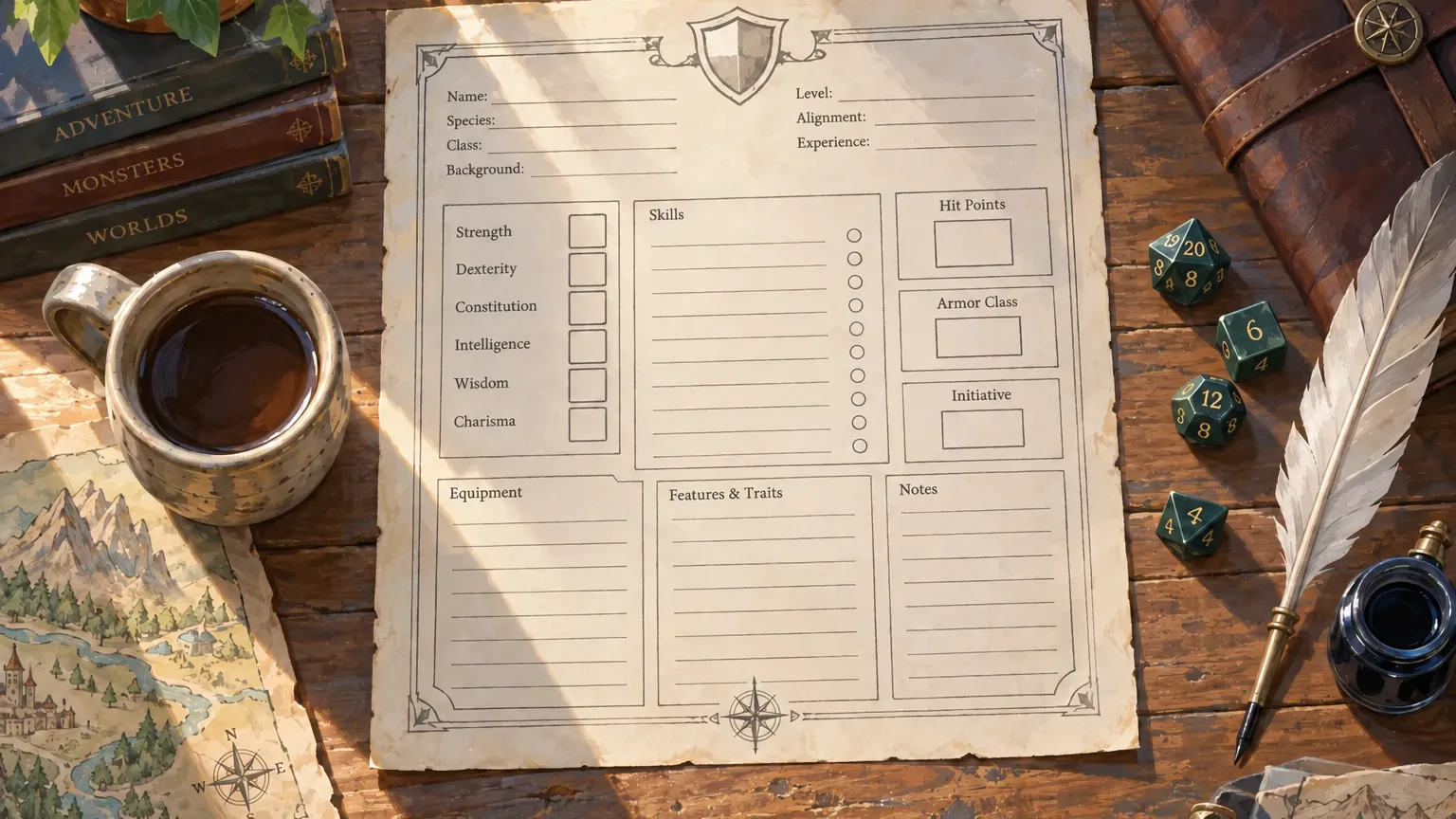
Every campaign needs more characters than a GM has time to invent: the fence the party will haggle with next session, a villain worth hating, and the player at session zero who wants help with a backstory. AI can help with all of them, but it has a pull toward the middle. In one study, stories written with an AI's ideas scored higher for novelty one at a time and came out 10.7% more similar to each other. In practice, the first cleric a chatbot gives you is probably close to the one it gives everyone.
Making characters work at the table is a GM problem with or without AI, so that comes first. After it: a method for getting AI past its first idea, and one worked example from prompt to finished NPC.
What makes a D&D character interesting at the table?
A character works when you can play them in the moment and the story has somewhere to put them. The GMs who write most about this, like Sly Flourish, the Angry GM, and the Alexandrian, disagree on plenty, but the same checks keep coming up:
- You can say what they want, and why, in one sentence.
- They're tied to something in the campaign you could put on stage, like a named person or a debt. Brennan Lee Mulligan's version is that a mysterious necromancer is a hook players can ignore, while "Your uncle, who you swore to kill, is here" is one they'll bite every time. More on that in writing plot hooks players won't ignore.
- A player character has a reason to be with this party. Sly Flourish asks it directly: "Why does my character want to travel with others?" An NPC has a reason to need the party.
- Their traits are specific. The 2014 Player's Handbook has the best example: "I've read every book in Candlekeep" tells you who someone is, and "I'm smart" doesn't.
- Their flaw is something another character could use against them, which is how the same book defines a flaw.
- You can find their voice from one line of dialogue and one mannerism.
- They're short, with blanks left in. Sly Flourish's rule is "one to five sentences instead of one to five pages", and Matt Mercer puts it as "back story is an invitation to the GM; not an expectation."
Run every AI draft against them.
NPCs fit on an index card
The Angry GM's two-note NPC is the reason the NPC is in the game, explained "in one SHORT sentence", plus "one – and precisely ONE – humanizing trait", written on an index card you keep in view while you play them. Swap the reason for what the NPC wants and add a secret, and the card tells you how to play them and why the party comes back.

Here's a shopkeeper on one card:
- Wants: to pay back the thieves' guild before winter. She borrowed a year's rent from them to pay a healer for her sister.
- Trait: overcharges the party on everything, then offers a steep discount for one small favor.
- Secret: the favor is carrying a sealed package across town, and it's guild business. The guild watches her shop, so she can't ask anyone for help openly.
That's enough to run her all campaign.
Villains need to show up early
A villain works when the players understand what they want and hate what they do. Let the party see the villain do something awful early, while they're still too weak to stop it, and have them cross paths a few times before the final fight.
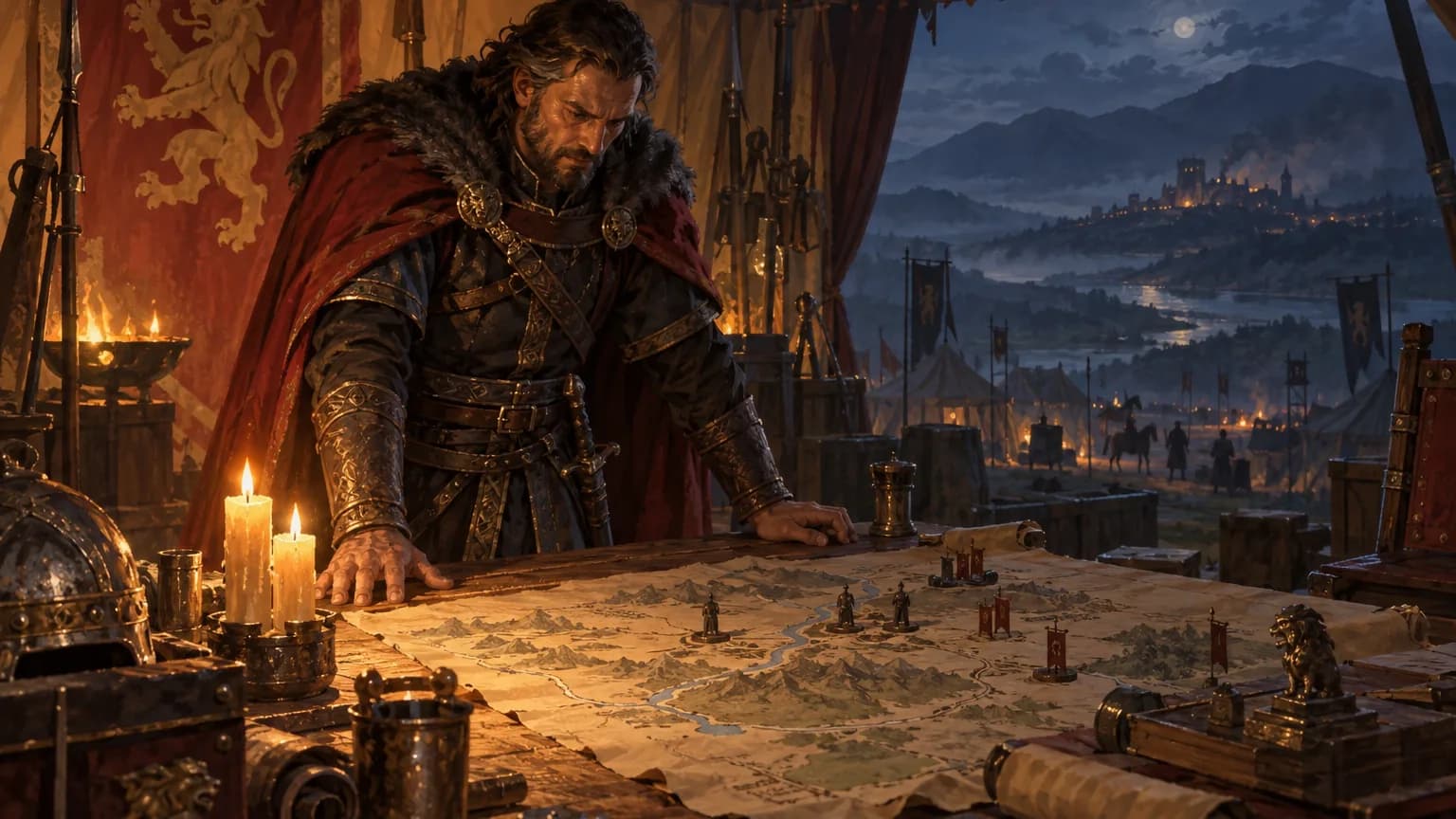
A warlord uniting squabbling city-states works better with a reason the players can argue with: a border war between those city-states burned his home village, and he believes one ruler beats another war. The party first hears of him as the man who burned the grain barges to end a siege in a week. His weakness is the lieutenant who knew him before the crown and still uses his childhood name, and the party's patron is one of the rulers he blames.
What to ask players for at session zero
Players will turn up with backstories of every length, some of them drafted with AI. Ask for the same things either way, and the FAQ at the end has the short list.
Why AI characters come out generic
- It converges. The study above found AI-assisted stories got better one at a time and more alike as a group. The first answer to "give me a cleric" is the most typical cleric.
- Its names come from a small pool. One study of AI creative writing found a model using "Elara" 85,513 times more often than human writers do, and a developer who asked Claude to name a software developer 100 times got "Marcus Chen" every time.
- Its characters are too agreeable. A 2026 study of generated characters found they "overwhelmingly comply" with whatever they're asked, which is the opposite of an NPC with something to hide.
How to use AI to create a DnD character, step by step
1. Give it your specifics first
Tell it the setting, the party, what the character is for, and what they want but can't have. Researchers testing story prompts found that the more constraints a prompt carries, the less the model can fall back on retelling stories it has already seen. Every detail you add makes a stock version of the character less likely.
2. Ask for ten, then keep one or two
Ask for ten concepts, each a different kind of story rather than ten variations on one. Researchers who studied brainstorming with GPT-4 found its ideas came out less varied than a group of people's, and that prompts which make it plan distinct ideas before writing them closed most of the gap. GMs who say AI works for them mention the many-then-choose habit again and again. One on D&D Beyond's forums put it this way: "Usually out of the 5 things I have it generate there might be 1 or 2 that lead to something fun/interesting."
3. Ask for the unlikely ones, in numbers
Ask for options the AI would be unlikely to suggest, and give it a number, like "each under 10% likely". Researchers call this verbalized sampling, and it made creative writing 1.6 to 2.1 times more diverse than asking directly. The number matters. In the example below, "how likely would you be to suggest each" came back as ratings between 73% and 96%, and "each under 10% likely" is what got the strange ones.
4. Decide the facts yourself, then have it write them up
The AI can pitch, but you decide what's true, starting with what the character wants and what they're hiding. Some GMs roll the facts on tables and only use the AI to turn them into prose. Either way, it stops the character defaulting to helpful and forthcoming.
5. Give them a name the AI didn't pick
Asking for another name mostly gets you a near neighbor: Elara becomes Elena. Bring names in from outside. Pick one real naming tradition for a place and take names from a historical list, like a tax roll or a guild register. Real surnames mostly name a place, a trade, or someone's father, which is why a merchant family called Wesenham or Parmenter sounds older than one called Ravencrest. To keep a whole culture's names consistent across a campaign, see AI D&D names that don't all sound alike.
6. Keep your own words in it
In a study of people co-writing with AI, the loss of variety came from the text the model contributed. The writers' own sentences stayed as varied as before. So write the lines that matter yourself, and use the AI as a critic ("what here is generic?") or as the character in an interview ("answer as her: what are you afraid the party will find out?").
What doesn't help
Telling it to "be more creative" isn't a reliable fix, and chat apps don't let you change the randomness setting anyway. Lists of clichés to avoid are unreliable too: models are measurably bad at being told not to mention something. Say what you want instead, like hard consonants or a name from a tax roll.
A worked example: a cleric who lost their faith

I set up a campaign for this post with a few sentences on each of three merchant houses in Bishop's Lenn, a river trade city, and on each player character. House Swerdeston owns the grain wharves and pays for the dockside chapel, House Wesenham insures the cargo and holds half the waterfront's mortgages, and House Parmenter runs the shipyards on cheap labor. The party is Hartwig Steenhus, a dwarf fighter who blames the Parmenters for the ambush that killed his caravan crew; Magot Brigge, a halfling rogue who still owes the Wesenhams for her mother's funeral; and Bartholomew Sistern, a wizard expelled from the university for reading a Swerdeston ledger. Nobody plays a healer. The names come from medieval King's Lynn, once Bishop's Lynn, and the Hanseatic League, which traded there, per step 5.
Steps 1 and 2 in one prompt:
I need a cleric NPC for this campaign: someone who has lost their faith and could end up traveling with the party, since nobody plays a healer. Using the houses and the player characters already in the campaign, give me 10 short concepts, each a different kind of story rather than variations on one. Tie each to one of the merchant houses and to at least one player character. One or two sentences each, and after each one put a rough percentage for how likely you'd be to suggest it.
It read the house and character documents and came back with ten pitches, each tied to a house and a player character, with a percentage after each. Four of them, unedited:
- The funeral witness: A former cleric at a Wesenham-mortgaged chapel could have officiated at Magot's mother's funeral, then watched the family's grief become another debt. Their faith broke over the cruelty of the arrangement; Magot is both the person they want to help and a reminder of what they failed to challenge. — 96%
- The repentant fraud: They sold dockside "protective blessings" while working around Parmenter's dry docks, knowing the words offered no guarantee; after someone relied on them, the lie hollowed out what little faith remained. Magot knows the waterfront routes—and may recognize the cleric's old tricks. — 82%
- The actuarial skeptic: A former cleric tied to the Wesenhams' insurance world tried to reconcile sermons about providence with cargo-risk figures, and lost faith when the numbers became a tool for justifying who mattered. Bartholomew's appetite for forbidden records makes him an irresistible, if irritating, traveling companion. — 86%
- The deserter: A former chaplain attached to a Wesenham-insured caravan abandoned it during an ambush, then lost faith when their survival was praised as providence. Hartwig's history makes joining the party a chance to face danger—and admit what they did. — 88%
Six of the ten lost their faith over a house's cruelty, which is the most obvious reading of this campaign: the pull toward the middle again, even with ten slots. And those percentages are recommendation strengths (it said so), running from 73% to 96% across all ten, so for step 3 I asked again with a number: "Now give me five more you'd be unlikely to suggest... each under 10% likely." Two of the five:
- The Gull Confessor — 6%. This former Parmenter dockside cleric believed harbor gulls carried people's confessions heavenward; faith ended when the birds started bringing back the little tokens used to mark the confessions. They want Magot to guide them through the waterfront roofs so they can question their feathered congregation.
- The Actuary of Providence — 5%. A former cleric tied to Wesenham's insurance business kept tally of answered prayers until their own figures convinced them nothing was listening. They join Bartholomew to look for a missing column in the ledger that will either restore their faith or make the arithmetic even worse.
The deserter is the one I'd use. Running from a fight is a real decision, the kind a player can argue with him about, and the ambush is already in Hartwig's backstory. So for step 4 I made it the same ambush: he was the chaplain on Hartwig's caravan, he ran, and Hartwig doesn't know he survived. I took the tally of answered prayers from the actuary, because a man counting zero is something I can play in one line. And the name comes off the King's Lynn list, with "Sir", which is how people addressed a priest at the time:
Let's go with the deserter, plus one detail from the actuary: he keeps a tally of answered prayers, and it's still at zero. Make it Hartwig's caravan. He was the chaplain on the caravan the Parmenters had ambushed, he ran, and Hartwig doesn't know he survived. He won't tell him. He wants to travel with the party because the Parmenters know he saw who gave the order. His name is Sir Walter Halyate (in Lenn, people call a priest 'Sir'). Write him up as an NPC document.
It wrote up exactly what I'd decided, linked him to Hartwig's and House Parmenter's documents, and put the ambush in a GM-only secret. Everything I hadn't decided came back as a blank, like his voice and what he tells the party about why he's joining. That's what I want from it at this point, because those are the things I'll find out at the table. My card for him:
- Wants: the party's protection. He tells them it's because nobody plays a healer.
- Trait: keeps a tally of answered prayers in a little book. It's at zero.
- Secret: he was the chaplain on Hartwig's caravan, he ran, and he saw who gave the order.
Against the checks at the top: one sentence of want, a named hook in Hartwig and whoever gave the order, a reason to travel with the party, a flaw the Parmenters can use, and blanks left for play.
Prompts to borrow
Swap in your own campaign. Each one lines up with a step above.
- "Using [your setting, the party, and what this character is for], give me 10 concepts for [role], each a different kind of story rather than variations on one. One or two sentences each."
- "Now give me five you'd be unlikely to suggest, each under 10% likely."
- "Here's what I've decided: [what they want, what they refuse, what they're hiding]. Write it up and leave anything I haven't decided blank."
- "Give me 20 surnames from [a real place and century], with what each one means."
- "Here's my draft NPC. Tell me what's generic about it and what contradicts the campaign. Don't rewrite it."
- "Answer as [NPC]: what are you most afraid the party will find out, and who would you betray first?"
- "Here's my player's backstory. Pull out every named person and place I could bring on stage, and suggest one question to ask the player."
Where Campaign Arks fits
Step 1 is the one that wears thin with a general chatbot: you paste the campaign in every time, and it still loses track of who owes whom. Campaign Arks is a session-prep assistant that works from the campaign you've already written. In the example above, the Workshop's Advanced mode (on Pro) read the house and character documents itself and tied every pitch to one of each. Sir Walter came back as a suggested document, linked to the documents he draws on, with his secret marked GM-only, and nothing enters the campaign until you accept it.
For how that fits into a normal week of prep, see the GM session prep cycle.
Prep your next session in Campaign Arks
Prep my next session · Free for one campaign, forever · No credit card
Frequently asked questions
Can AI make a D&D character sheet or stat block?
It can suggest ability scores, class features, and stat blocks, but it often mixes the 2014 and 2024 rules and invents things that don't exist. When a D&D Beyond forum poll in April 2026 asked whether people use AI to help build their characters or campaigns, 80.9% picked "No, it doesn't understand the rules properly." Build the sheet in the official rules or a character builder, and use AI for backstory, personality, and ties to the campaign.
How do I stop AI characters sounding the same?
For concepts, follow the steps above. For dialogue, give each NPC one speech habit you choose yourself (clipped, formal, answers questions with questions) and write their first line before you ask the AI for any more. It will match a voice it can see far better than it invents one.
How do I keep an AI-made NPC consistent across sessions?
Write the NPC down as a short card (what they want, one trait, one secret) and check each new scene against it before you run it. Whatever you use to prep, the card is the source of truth, not the chat history.
What should I ask players to bring to session zero?
One to five sentences, one thing the character wants, one named person or place you can use, a reason to travel with this party, and a blank or two for you to fill. Ask for it a week before the session, so you have time to hook it into your prep, and tell them up front that you'll fill the blanks.