25 NPC Ideas for DnD and What They Do Next
Twenty-five people for your campaign, each with a line to open with and how they come back after the party's choice
October 30, 2026

Here are 25 NPC ideas for D&D, each with a line to open with and a note on what the NPC does the next time the party meets them, depending on what the party did the first time. That second part is what makes an NPC feel like a person, someone who remembers how the party treated them and comes back changed by it.
Most lists of NPC ideas stop at the first meeting, and that's where the hard part starts. Among the highest-voted NPC questions on RPG Stack Exchange, several are about what happens afterward: a player who wants to recruit every NPC into the party, players who can't tell when an NPC has stopped being useful, and players who kill an NPC outside combat. After the list, one idea is worked through three appearances in a single campaign.
What makes an NPC idea work at the table?
An NPC idea needs a want of its own. The Alexandrian's tip for memorable NPCs starts with "Give the NPC a strong agenda. Make them want something," and adds that "It actually works best if this agenda is not aimed directly at the PCs." The reason is how players read it: "the less the players think “X exists because the GM wants us to do Y,” the more they will think of X as an actual person." The Angry GM makes the same point about quest givers: when players later learn an NPC hired them under false pretenses, "that makes the world feel alive."
Beyond the want, it needs very little. The Angry GM's two-note NPC is a reason in "one SHORT sentence" and "one – and precisely ONE – humanizing trait." The Alexandrian's NPC template adds a mannerism, because "You’ll find that you can quickly get back into the character by simply performing the mannerism." A line of dialogue does the same job, which is why every idea below has one. Detail beyond that is mostly wasted on a minor NPC. At Gnome Stew, Matthew Neagley warns that "Carefully crafted, deeply realistic emotional motivations are wasted on an NPC that gets a half to ten minutes of spotlight time." The guide to making characters turns this into an index card: a want, one trait, and a secret.
It also needs a next time, which is the part most NPC ideas leave out. Phil Vecchione's routine for location-based campaigns is to "think of how the NPCs and Organizations will react to the actions of the PC’s," which "may move the NPC or Organization from one group (friendly, neutral, hostile) to another." Sly Flourish asks the same thing between sessions in The Lazy Dungeon Master: "Where have your NPCs been? What have they been doing while the PCs have been going about their business?"
You don't have to choose which NPCs will matter. The Alexandrian's advice is to "Throw out lots and lots of NPCs and then pay attention to which ones “click” with the players," and Sly says the same in The Lazy Dungeon Master: "the players will often choose for you." Pick a few of the ideas below, put them in front of the party, and write the next time only for the ones the players take to.
Seven NPCs who need something
Each of these wants something the party could help with, and goes after it anyway if the party says no.
1. The town leader with no good choice
The mayor has two options, and both cost people their homes. Open the dam and the lower farms flood. Keep it shut and the mill town upstream loses its harvest. What the mayor wants is someone to share the decision, and newcomers make convenient people to blame.
Opening line: "Whatever I choose, someone in this town loses. Tell me which someone you can live with."
Next time: if the party picked a side, the families who lost are waiting for them, and the mayor has let the town believe it was the party's idea. If the party found a third way, they're the first people the mayor asks about the next impossible thing. If they walked away, the mayor chose alone, and half the town blames the party for not helping.
2. The healer who can't save everyone
Three beds, eleven patients, and herbs for maybe half of them. The healer wants supplies and hands, and when those run out, someone else to decide who gets treated first.
Opening line: "I have three beds and eleven patients. Help me choose, or leave."
Next time: the patients the party helped save remember them. Make one of them matter later: the guard captain's son, or a smuggler who now owes them. If the party left, the healer kept making the choices alone and has gone colder for it, and their price for patching up the party has gone up.
3. The scholar one page short
They've translated the dead languages and read the banned books, and one missing page stands between them and knowing why something was buried. They'll pay for that page, lie for it, or hire someone worse than the party to find it.
Opening line: "One more page. I just need one more page, and I'll know why they buried it."
Next time: if the party brought the page, the scholar knows, and someone else has noticed. Their study has been searched and they want protection. If the party refused, the scholar hired a less careful crew, and whatever that crew dug up is now loose.
4. The old enemy who needs help
The last time the party saw them, somebody drew a weapon. Now they're at the door asking for help against something worse than their grudge. They want to survive it, and they'd rather not owe the party anything afterward.
Opening line: "I hate that I'm here. I hate more what's coming if I'm not."
Next time: a truce that held leaves them owing the party, and they resent it. They'll repay it at the worst possible moment, or try to settle it early so they're free to be enemies again. If the party turned them away, they made a deal with whatever was coming, and now they're on its side. "Great recurring villains aren’t created, they evolve," Walt Ciechanowski writes at Gnome Stew, and this is one way it happens.
5. The monster with young
The party walks in expecting initiative and finds an owlbear standing over a den, or a troll raiding farms because miners drove off its game. It wants its young alive and the intruders gone.
Opening line: none. It stands between the party and the den, and it doesn't attack first.
Next time: if the party backed away, the creature becomes part of the place. Nothing else hunts that valley, and the party's camp is left alone when the rest of the road isn't. If the party killed it, one of the young survived, and in a few levels it's grown. If the miners caused it, they've already moved deeper into the hills.

6. The ghost who can't move on
They've walked the same hallway for eighty years, and they want one thing finished: a name spoken aloud, a letter delivered, a body moved to consecrated ground.
Opening line: "I've walked this hall for eighty years. Someone, please, just say her name."
Next time: a ghost laid to rest leaves its unfinished business to living heirs, and not all of them are glad. A will now stands, and land changes hands. If the party didn't, the ghost grows bolder and starts walking farther, and the village has noticed.
7. The noble who wants an ordinary life
They have a title, an arranged future, and hands that have never done a day's work. They want to disappear into ordinary life, and they're bad at it: they pay for bread with gold and don't know what a blister is.
Opening line: "Please don't bow. Nobody here bows. Please."
Next time: if the party hid them, the family's agents arrive with a reward for the noble's return and a charge of kidnapping for whoever helped. If the party sent them home, the noble is back behind the walls. In ten years they'll have power and a long memory of who did it.
Six NPCs who know things
Information is the easiest thing an NPC can give the party, and the easiest to make cheap. Each of these wants something for what they know.
8. The retired adventurer
They swore off adventuring years ago and still know where the tomb is, the one that officially doesn't exist. They want to stay retired, and they tell the party half of what they know, because the other half is how their friends died.
Opening line: "I've buried better swords than that one, kid. Doesn't mean I'm digging them up for you."
Next time: if the party came back alive from the place the veteran warned them about, the veteran asks the question they've avoided for years: did you find my friends? If the party ignored the warning and paid for it, the veteran takes their own sword down off the wall.

9. The information broker
Ask the price of rope and the conversation somehow ends on a rumor about the duke's missing ring. The broker wants to stay useful to everyone and owe nobody, and keeps a ledger of who has paid with what.
Opening line: "Rope's two silver. The truth about the duke's ring costs a bit more."
Next time: whatever the party paid with is now the broker's to sell. If they paid with a secret, the next customer buys it. If they never paid at all, the broker sells their movements to whoever asks.
10. The child who saw something
They saw something in the woods, or heard it through a wall, and nobody listens to a kid. The child wants someone to believe them. The information comes out sideways: a drawing, a game they keep playing that is really a memory.
Opening line: "The shadow man told me not to tell. But you're nice, so."
Next time: if the party listened, the shadow man knows someone did, and the child is the one who saw him. If the party didn't, the child told someone else, and the wrong person believed them.
11. The stranger who turns up at the right moment
They arrive with a warning, an unlocked door, or a name, and they're gone before anyone thinks to ask theirs. Decide what they want before their second appearance, even if the players won't learn it for months, and let one clue to who they are slip every few appearances.
Opening line: "Don't go through that door tonight."
Next time: a stranger whose warning was heeded asks for something back, and it's small enough that saying no feels petty. If the party ignored the warning, the stranger stops being polite and is already waiting inside the party's rented room.
12. The villain's former ally
They stood next to the villain once, maybe drew up the plan, and they've spent years trying to undo the damage. They want to make it right, and they'd like to be forgiven, though they'll settle for being useful.
Opening line: "I helped build the thing that's hunting you. I'd like to help tear it down, if you'll let me."
Next time: if the party trusted them, the villain has heard they've switched sides, and the party now has someone to protect. If the party refused, they tried alone and were caught, and everything they know reaches the villain.
13. The fake expert
They talk a much bigger game than their skills, with total confidence and plenty of names dropped. They want to be taken seriously, and when it matters, they come through often enough to keep everyone guessing.
Opening line: "Of course I've fought a beholder. Several, actually. Mostly in spirit."
Next time: covered for, they've told the story everywhere with themselves as the hero, and someone has hired them for a job far beyond them. They come to the party for help. If the party exposed them, they've moved one town over and are still telling stories, now about the party.
Seven NPCs with their own plans
These have plans that cross the party's path. They're the ones most likely to make the campaign move while the party is looking elsewhere.
14. The rival adventurer
Another party wants the same bounty, the same ruin, and the same reputation, and their leader keeps arriving one step ahead. The Alexandrian's advice on running the rivals in Call of the Netherdeep works for any rival: follow "the Principle of Opposition: Whatever the PCs think is the right course of action? The Rivals have the opposite opinion," and "actively play the Rivals in the same way that your players are actively playing their PCs."
Opening line: "Cute plan. We tried it last week."
Next time: if the party beat them fairly, the rival comes back better, having learned from the loss, and buys the first round. If the party cheated, the rival comes back with a grudge and a bigger crew. For a rival party as a whole campaign layer, see the rival adventuring party idea.
15. The rival from a character's past
This one is aimed at one character: an old flame, a sibling who stayed, a mentor who feels betrayed. Ask the player before you use it. Give the rival something they want from the whole party too, so the rest of the table isn't just watching.
Opening line: "You left without saying goodbye. I've had a long time to think about that."
Next time: if the character made peace with them, the rival asks the character to choose between the party and the life they left. If the character brushed them off, the rival takes everything they know about that character to the party's enemies.
16. The envoy with a second agenda
They talk like a diplomat and negotiate like one, right up until you notice they never answer the question you asked. They want what their faction officially wants, and something else it doesn't say out loud.
Opening line: "My guild wants peace. What we mean by 'peace' is, admittedly, negotiable."
Next time: if the party did the job, the faction got what it really wanted, and the party learns what that was from the people it cost. If they refused, the envoy hired someone else, and the faction now counts the party as a problem.
17. The lieutenant who wants the boss's job
The villain's second in command wants the villain's chair, and the party is the tool to get it. They feed the party good information about the boss, timed so that the party does the dirty work. At Gnome Stew, Kurt Schneider's advice for a recurring rival fits here: "Make sure they have an obvious exit strategy, and then a second, not-so-obvious strategy."
Opening line: "She'll be at the ford at dawn with four guards. I'd bring more than four friends."
Next time: if the party took the information and the boss fell, the lieutenant is the new boss, and knows exactly how the party fights. If the party warned the boss instead, the lieutenant is on the run and needs the party to keep them alive.
18. The criminal with a code
They'll rob a merchant blind without blinking, but they won't take from a child or break a promise once it's made. They want money and to keep that one rule, and players can never be sure which side of it they'll land on.
Opening line: "I'll take your coin. I won't take a child's toy. Don't ask me why."
Next time: respect the code, and the criminal does the party a favor that breaks some other law. Make them break it, and they're done with the party and maybe with crime, which makes them a witness.
19. The local hero with a cover story
Everyone in town can tell you about the night the hero saved the harvest or pulled a child from a fire. Not every word of it is true. They want the story kept as everyone remembers it. Let the cracks show slowly, through a detail that doesn't line up.
Opening line: "Everybody tells it better than I do. Ask the miller, he was there."
Next time: if the party exposed them, the town turns on the party first, because they loved their hero. If the party kept the secret, the hero owes them, and the person who really saved the town is still out there.
20. The inventor
Somewhere in a cluttered workshop, something is ticking, glowing, or muttering in a language nobody taught it. The inventor wants funding, a rare part, or a volunteer.
Opening line: "It only explodes sometimes. I've mostly worked out which times."
Next time: with the party's help the device works, and now three factions want it, and the inventor with it. Without it, someone else funded the work, and the next version is already pointed at something.
Five NPCs the party's choices create
These come out of something the party did, which makes them the easiest NPCs to bring back. The party already knows why they're there.
21. The hireling who wants a bigger share
The torchbearer, porter, or guide who's been with the party since the first dungeon wants better pay, a share of the treasure, or to be asked their opinion. The Alexandrian notes in his Ptolus campaign that once an NPC is firmly on the party's side, "it feels almost inevitable that they’re going to turn invisible." A hireling with a want of their own stays visible.
Opening line: "Same pay as the first day. I've carried you out of two crypts since then."
Next time: if the party paid fairly, the hireling brings a cousin who wants work, and the party now has people depending on it. If not, the hireling quits, and everyone at the hiring hall hears why.
22. The creditor
The party bought gear on credit, or someone paid their fine. The creditor wants the money back with interest, and is patient in a way that makes it worse.
Opening line: "No hurry. I'll put it in the ledger. I put everything in the ledger."
Next time: paid back, the creditor offers a bigger loan, with a small favor attached. If the party didn't, the debt has been sold to someone much less patient.
23. The survivor
Someone lived through what the party did: the bandit's widow, the guard they knocked out, the cook in the castle they stormed. They want back what they lost, or at least an explanation.
Opening line: "You probably don't remember me. You were busy."
Next time: if the party made amends, the survivor becomes an unlikely ally who knows the inside of a place the party will need again. If the party brushed them off, they take their story to the party's enemies.
24. The impostor using the party's name
The party's reputation reached the next town before they did, because someone there has been claiming to be them, collecting their rewards, and running up their bar tab. The impostor wants the fame without the danger.
Opening line: "I only borrowed the name. You weren't using it here."
Next time: if the party exposed the impostor in public, the debts still land on the party until somebody pays them. If the party let it go, the impostor's version of the party is famous now, and its deeds keep getting pinned on the real one.
25. The villager who becomes a major figure
A farmer whose field became a battlefield, or a shopkeeper whose town picked a side they didn't choose. They want something small, like their land or their family, that the big conflict threatens. In session one, nobody at the table remembers their name. By session twenty, they might lead the town council, or a rebellion, depending on what the party did for them.
Opening line: "Somebody has to say it at the meeting. Seems like it's going to be me."
Next time: worked through below.
Every idea at a glance
"Drop in when" is the moment in a campaign where the idea fits most easily.
| Idea | Wants | Drop in when |
|---|---|---|
| 1. Town leader with no good choice | Someone to share the decision | The party has a reputation in town |
| 2. Healer who can't save everyone | Supplies, hands, a decision | After a battle or an outbreak |
| 3. Scholar one page short | The missing page | The party is heading somewhere old |
| 4. Old enemy who needs help | To survive, without owing anyone | A bigger threat is coming for both |
| 5. Monster with young | Its young alive, intruders gone | Any monster-hunting job |
| 6. Ghost who can't move on | One thing finished | The party sleeps somewhere old |
| 7. Noble who wants an ordinary life | To disappear | The party travels with common folk |
| 8. Retired adventurer | To stay retired | The party needs a warning or a map |
| 9. Information broker | To owe nobody | The party is stuck on a lead |
| 10. Child who saw something | To be believed | A mystery needs a first clue |
| 11. Stranger at the right moment | Something you decide before visit two | The party is about to walk into a trap |
| 12. Villain's former ally | To make it right | The villain is still out of reach |
| 13. Fake expert | To be taken seriously | The party needs a guide they can't afford |
| 14. Rival adventurer | The same prize | The party has a goal others want |
| 15. Rival from a character's past | Something from one character | A player has given you a backstory |
| 16. Envoy with a second agenda | What the faction won't say | Factions are starting to matter |
| 17. Lieutenant who wants the boss's job | The villain's chair | The party is closing on a villain |
| 18. Criminal with a code | Money and one rule | The party needs something done quietly |
| 19. Local hero with a cover story | The story kept as told | The party arrives somewhere new |
| 20. Inventor | Funding, a part, a volunteer | The party has money or a rare find |
| 21. Hireling who wants a bigger share | A fair share | The party has had hired help a while |
| 22. Creditor | The money, with interest | The party is broke or in jail |
| 23. Survivor | What they lost | The party left a mess behind |
| 24. Impostor using the party's name | Fame without danger | The party has a name worth stealing |
| 25. Villager who becomes a major figure | Their land, their family | A big conflict reaches ordinary people |
How do you bring an NPC back changed?
Here's idea 25 worked through three appearances, in Wythe Fen, the campaign from 20 TTRPG campaign ideas. The party are hired hands on a lord's crew sent to drain a fen. The village that lives off the fen keeps its floods away with an old bargain: every spring at the equinox, one villager walks into the fen and doesn't come back. This year it's the reeve's daughter, Joan.
Before the first session, the reeve's nephew gets a card:
Wat Reder, the reeve's nephew. Wants: his cousin Joan not to walk into the fen. Trait: answers a question with a question. Secret: he's the one who will open the sluice gate on the crew's first night. With the party: neutral.
First appearance: the sluice gate
On night one, the party catches Wat at the open gate. Asked why, he asks back: "What would you do, if it was your cousin?" He doesn't explain the bargain. He begs them to let him go.
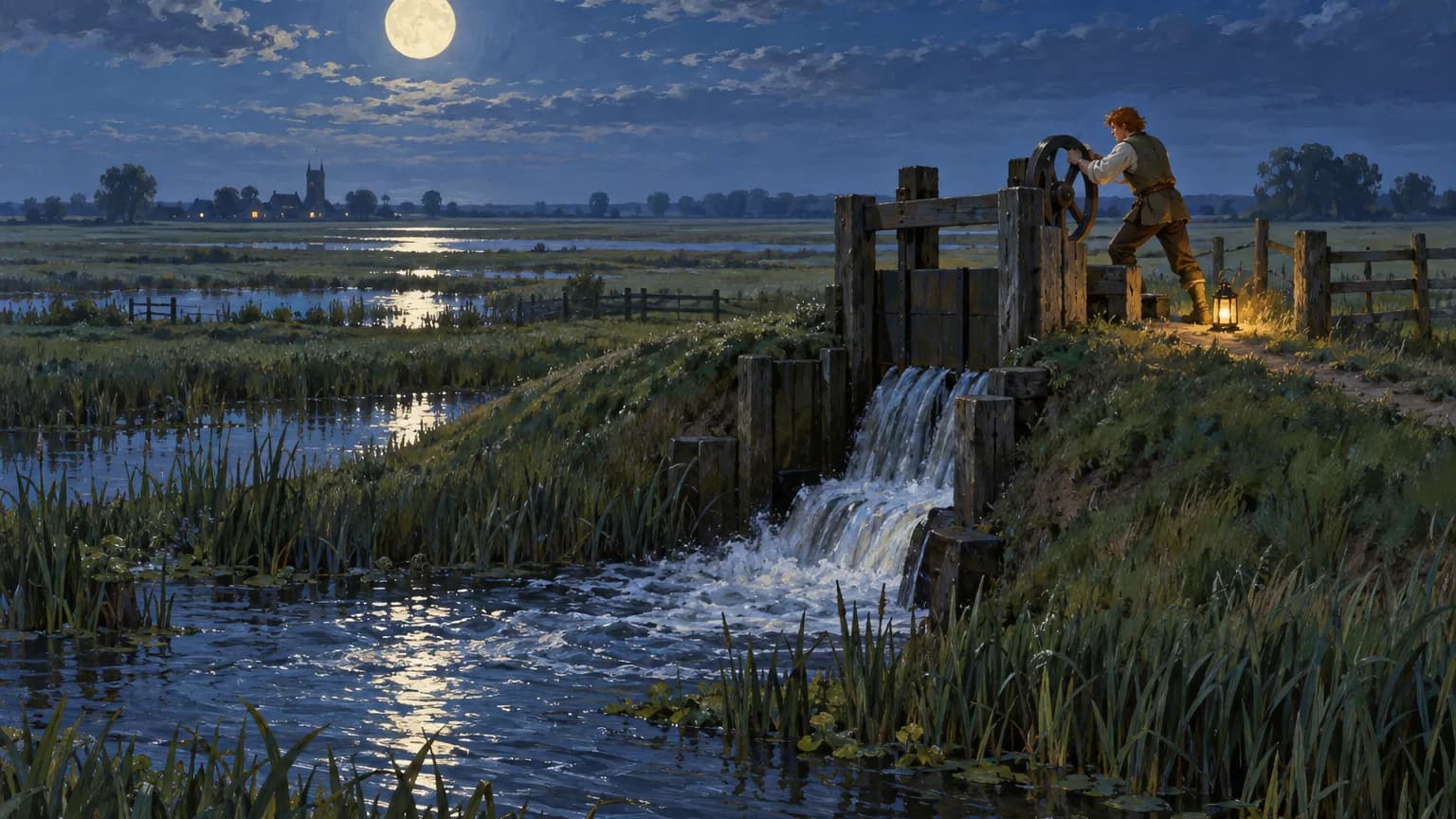
Say they do. Wat now owes them, and he knows they can keep a secret. Move him to friendly. If they hand him to the steward instead, Wat spends a week in the lockup, and the reeve's offer to the party on day five comes colder.
Second appearance: the white shift
On day seven, Joan is measured for a white shift, the dress she'll walk into the fen in. If the party let Wat go, he comes to find them and tells them what the shift is for, because they're the only people who aren't from the village. If they turned him in, he doesn't come. The party hears about the shift from crew gossip, and Wat is planning something alone.
Watch how the players take to him. If they ask after Wat by name, he's clicked, and he's worth more of your prep.
Third appearance: the night before the equinox
If the party helped him, Wat stands up at the village meeting and says out loud what nobody has said in living memory: nobody walks this year. Half the village follows him. Now he's a figure the reeve has to answer to and the steward wants to use, and Joan's fate is a question the whole campaign turns on.
If the party didn't help, nobody stands up at the meeting. At dawn on the equinox, Wat reaches the fen's edge before Joan does and walks into the water in her place. The village blames the drainage crew, which means the party.
Either way, the card changes. The Angry GM's rule is that when an NPC reveals a new trait in play, "you need to write that trait on the back of the NPCs card." After the third appearance, the back of Wat's card might read:
Stands up when nobody else will. Half the village follows him. With the party: ally (they let him go at the gate, and stood with him at the meeting).
That's all the prep each appearance needed: the card, and one line for each way the party could have gone. To keep the steward, the village, and anyone else moving between sessions, the guide to creating a D&D campaign that feels alive works through the same campaign from the factions' side.
Where Campaign Arks fits
The hard part over a long campaign is remembering where each NPC stands with the party, and why. Campaign Arks is a session-prep assistant for GMs, and it keeps each NPC as a document: who they are, what they want, and where they stand with the party. That last part is a field you set, from antagonist through rival, neutral, and friendly to ally, and the Knowledge Base can filter your NPCs by it, so you can see who's on the party's side before a session. Each NPC also has a status (active, retired, or deceased) for the ones who've left the story. On Pro, the Workshop assistant reads your campaign's documents and can suggest edits to existing ones, so after a session you can ask it to update Wat's document with what happened at the meeting, and accept or dismiss what it suggests.
Prep your next session in Campaign Arks
Prep my next session · Free for one campaign, forever · No credit card
Frequently asked questions
How many NPCs should I prepare for a session?
Fewer than you'd think, with a list of spare names for the rest. Sly Flourish suggests "Keeping a list of 100 or so random names on hand", and in The Lazy Dungeon Master says secondary NPCs "probably don't need much more than a name and a primary occupation. The rest can come about organically." Prep a card for the NPCs the next session is likely to put in front of the party, and improvise the rest. When an improvised NPC clicks with the players, give them a card afterward.
What if my players want to recruit every NPC into the party?
Let the NPC's own want answer it. An NPC who has somewhere to be, like the healer with eleven patients or the scholar chasing a page, has a reason to say no that isn't the GM saying no. The ones who do join need a want of their own, or they turn invisible. The hireling is idea 21 because of this.
How do I keep players from killing an important NPC?
Mostly, you don't. If an NPC dies, let it change something: the survivor (idea 23) is often someone the dead NPC left behind, and the lieutenant (idea 17) is waiting for the chair to come free. Gnome Stew's Walt Ciechanowski advises against designing a villain to recur at all, because "doing so only forces me to artificially protect him in order to keep him around."
How do I help players remember NPC names?
Bring the NPC back. An NPC the party has met twice, with a line and a mannerism that stay the same, is easier to remember than a name they've only heard once. Use names that are easy to say, give each NPC one consistent habit, and keep a list of who the party has met where the players can see it.
How do I give NPCs different voices without doing accents?
Change how they talk rather than how they sound. Give each NPC one speech habit, like Wat answering a question with a question, or the creditor saying "ledger" in every second sentence, and write their opening line before the session. The Alexandrian's mannerism works the same way: one physical habit you perform every time the NPC speaks.